

If you’ve recently been in a car accident, you may be wondering if your neck soreness is something that will go away on its own—or if it’s the beginning of a whiplash injury.
One of the biggest misconceptions about auto accidents is that if you don’t hurt immediately, you must be okay. In reality, many people don’t begin feeling pain until 24 to 72 hours after the accident. This delay is often caused by inflammation that develops over the first few days after an injury.
As a chiropractor, I see this every week. Patients often tell me, “I felt fine the day of the accident, but two days later I could barely turn my head.” That’s why it’s important to understand what whiplash is. What symptoms to watch for, and when it’s time to get evaluated.
What Is Whiplash?
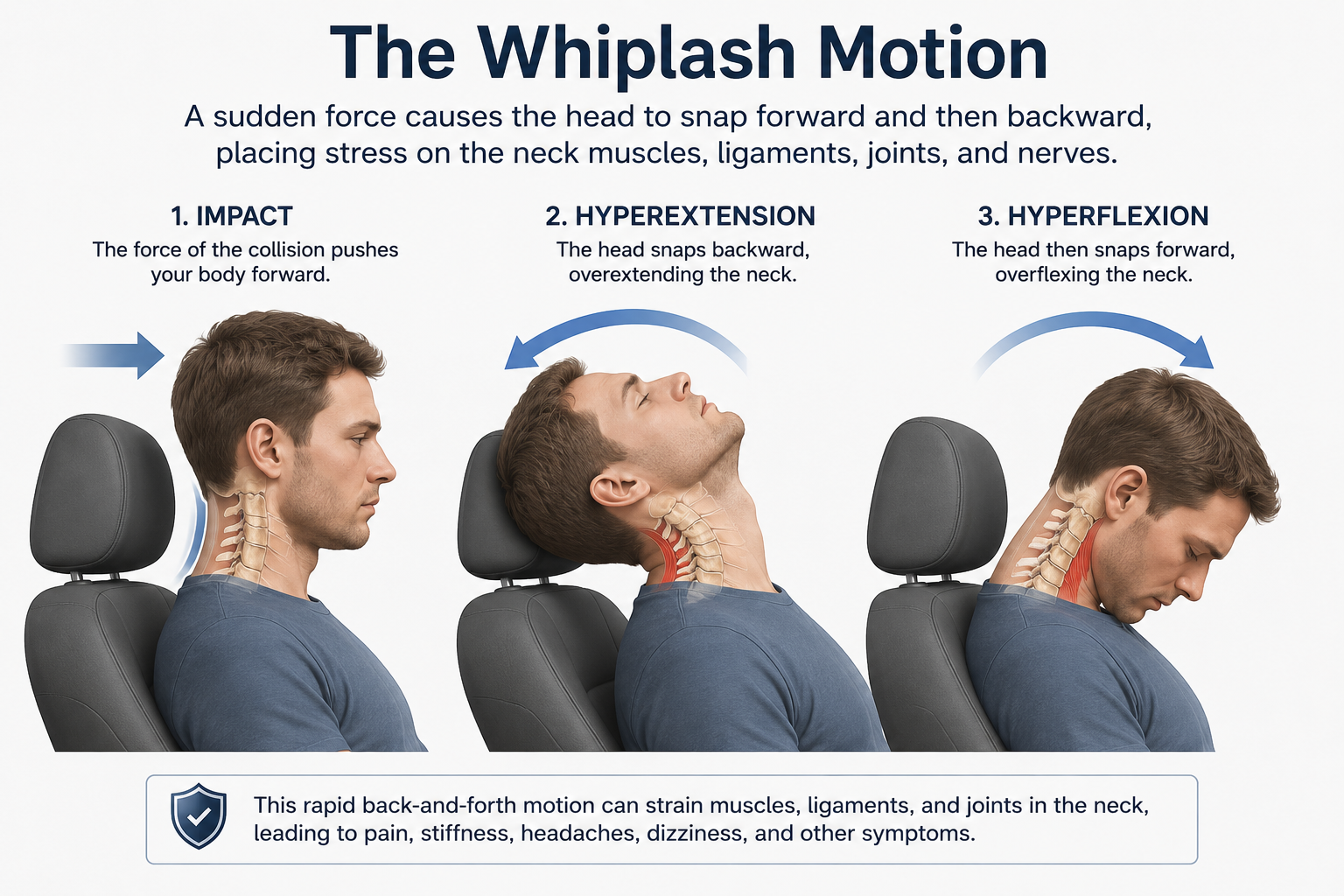
Whiplash is a soft tissue injury that occurs when the head is suddenly thrown forward and backward during an impact. Even low-speed collisions can create enough force to strain muscles, ligaments, joints, and nerves in the neck.
Although the neck is most commonly affected, whiplash can also cause injuries in the shoulders, upper back, lower back, hips, and even the arms.
Common Symptoms of Whiplash
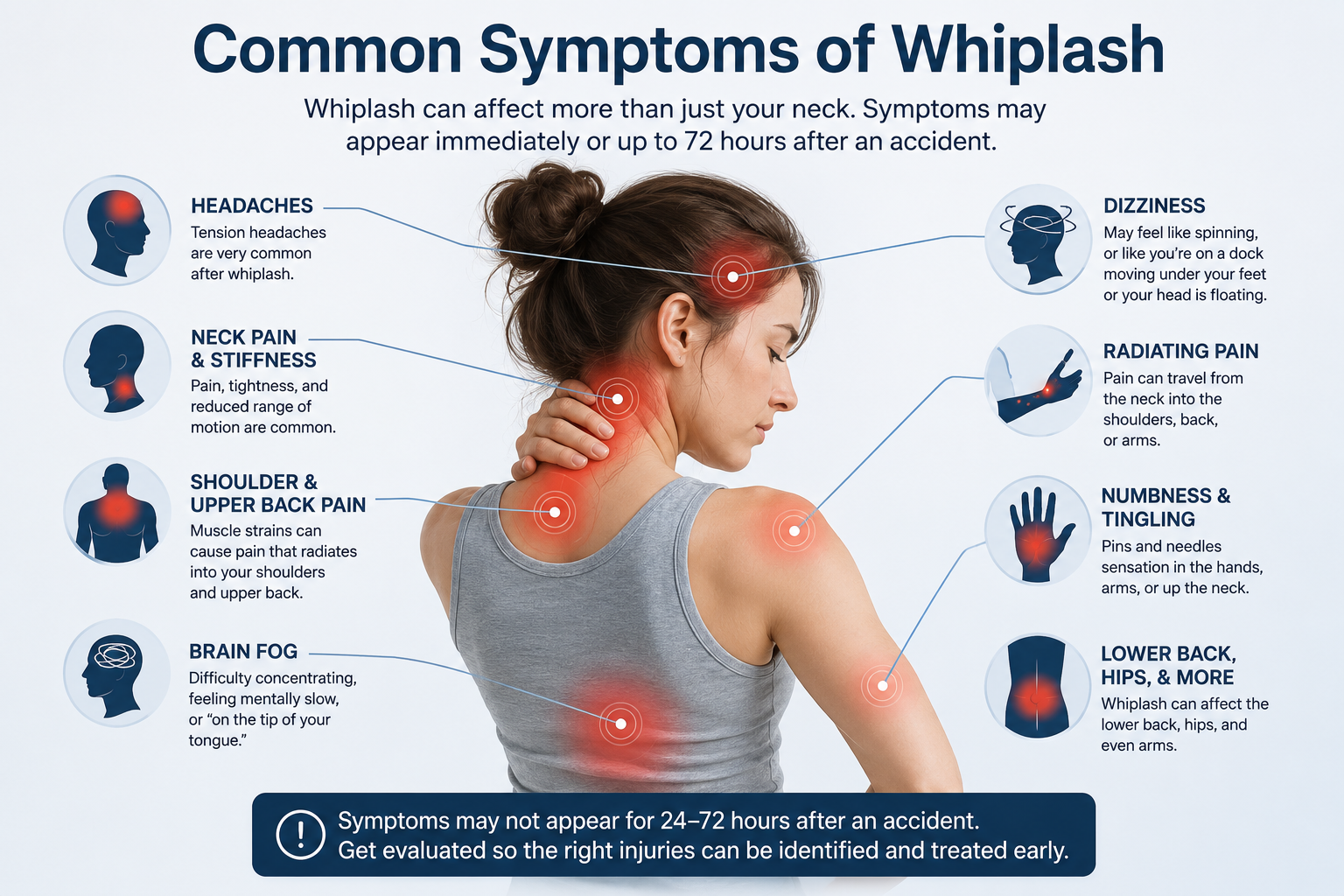
Every injury is different, but these are the symptoms I see most often:
Neck pain and stiffness
Headaches
Pain that travels into the shoulders or upper back
Pain or numbness traveling into the arms
Tingling or “pins and needles” in the hands
Brain fog or difficulty concentrating
Dizziness or feeling off balance
Shoulder pain
Jaw discomfort
Muscle tightness throughout the upper body
One symptom many people struggle to describe is brain fog. Patients often tell me it feels like they know the answer to a question, but the thought is just out of reach—“it’s on the tip of my tongue.”
Others describe dizziness that isn’t spinning like vertigo. Instead, they say it feels like standing on a dock that’s gently moving beneath their feet, or as if their head is floating above their body. These symptoms can be signs that the nervous system has been affected by the injury.
Why Symptoms Often Get Worse Before They Get Better
One thing that surprises many patients is that recovery isn’t always a straight line.
It’s common for pain to improve after a week or two, only to flare up again after spending a day shopping, working in the yard, cleaning the house, or returning to normal activities.
This doesn’t necessarily mean you’ve reinjured yourself. More often, it’s a sign that the injured tissues haven’t fully healed yet. As activity increases, inflammation can increase as well, causing symptoms to return temporarily.
Understanding these “ups and downs” helps many people avoid becoming discouraged during the healing process.
What Happens During an Evaluation?
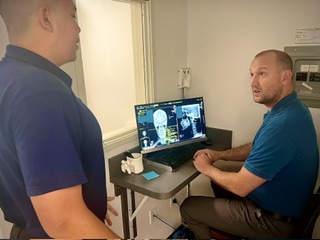
Every injury deserves an individualized evaluation.
At our office, we begin by understanding exactly how the accident occurred. Questions like these help us better understand the forces involved:
What direction did the impact come from?
How fast were the vehicles traveling?
Were multiple vehicles involved?
Was there more than one impact?
Did your vehicle strike anything after the initial collision?
Next, we perform a physical examination that may include:
Motion testing
Orthopedic testing
Neurological testing when numbness or tingling is present
Evaluation of the injured joints and muscles
When appropriate, we also take X-rays to help evaluate traumatic injuries, rule out fractures, and guide treatment recommendations.
Sometimes an evaluation uncovers injuries patients didn’t even realize they had. It’s not uncommon for someone to discover a sore forearm, shoulder, or wrist after we begin examining the area, simply because the neck pain was masking everything else.
If additional care is needed, we coordinate with other healthcare providers, including physical therapists, massage therapists, acupuncturists, orthopedic specialists, neurologists, and primary care physicians. The goal is always to build the right team for each patient’s recovery.
How Chiropractic Care Can Help
No two chiropractic offices are exactly alike, but treatment often includes several approaches to help injured tissues heal.
Depending on your specific injuries, treatment may include:
Gentle chiropractic adjustments
Instrument-assisted soft tissue therapy (muscle scraping)
Cupping therapy
Pin-and-stretch techniques
Electrical muscle stimulation (E-Stim/TENS)
Muscle taping
Therapeutic exercises
Bracing when appropriate
Stretching instruction
Nutrition recommendations to support healing
The purpose of treatment isn’t simply to reduce pain. It’s to improve movement, reduce stress on injured tissues, and restore function. The goal is to help your body recover as completely as possible.
Recovery Takes More Than Pain Relief
One of the biggest mistakes I see is people ending treatment because their pain has become manageable.
Pain is only one part of recovery.
If you can sit comfortably at work but can’t turn around to reach something in the back seat of your car, you’re probably not fully healed.
If you can make it through your workday but can’t enjoy gardening, golfing, cooking with your spouse, or playing with your kids without symptoms returning, there’s still progress to be made.
My goal isn’t simply to help patients hurt less.
My goal is to help them get back to living the life they enjoyed before the accident.
A Patient Story
One patient came to our office after a significant whiplash injury. She had headaches, neck pain, shoulder pain, mild dizziness, and pain traveling into her right arm.
After about six months of treatment, most of her pain had resolved. She rated her discomfort very low and felt she was doing well.
But something still wasn’t right.
She and her husband loved cooking together, yet every time they turned on the stove’s exhaust fan, the humming sound became incredibly irritating. The pain wasn’t severe—but the noise was almost unbearable.
As her neck continued to recover, that sensitivity gradually disappeared.
If we had stopped care simply because her pain score had reached zero, she might never have fully returned to one of the activities she loved most.
That’s why we measure recovery by more than a pain scale.
Recovery Timeline

Every person heals differently.
Recovery depends on several factors, including:
The severity of the collision
Previous injuries
General health
Age
Daily physical demands
How quickly treatment begins
In general, many people recover within these timeframes:
Minor injuries: 2–6 weeks
Moderate injuries: 2–4 months
More significant injuries: 6–12 months
Starting care sooner often helps identify injuries early and gives your body the best opportunity to heal efficiently.
Dr. Johnson Says
“If you’ve been in a car accident, get evaluated—even if you think you’re okay.”
I don’t believe chiropractic is the answer for every person or every injury. Sometimes the best care comes from a medical doctor, physical therapist, orthopedic specialist, neurologist, or another healthcare provider.
What I do believe is this:
Don’t ignore an accident.
Getting evaluated helps identify injuries early. It provides peace of mind if you’re doing well. It ensures you receive the right treatment if something needs attention.
Can We Help?
At Cascade Chiropractic & Wellness, we regularly care for people recovering from auto accidents throughout the Portland area. Every injury is different, which is why every patient deserves a thorough evaluation and an individualized treatment plan.
Whether your symptoms began immediately or several days after your accident, our goal is simple: help you recover fully so you can get back to doing the things you love.
If you’ve recently been in a car accident and have questions about your recovery, we’d be happy to help you determine the next step.
Sources & Further Reading
- Mayo Clinic – Whiplash: Symptoms and Causes
- MedlinePlus – Whiplash
- Journal of Orthopaedic & Sports Physical Therapy – Neck Pain Clinical Practice Guidelines
- American Academy of Family Physicians – Cervical Spine Evaluation After Trauma



Leave A Comment